Rules and play
Thu 25 December 2025
What do you look for in an RPG ruleset? Is 5e your comfort food? Do you like Only War's pages of crunchy roll-tables? Do you go for something 'rules-lite' and narrative-focused like Powered-by-the-Apocalypse systems? Do you dare (gasp) make up your own rules from scratch?
My friends and I have talked through this question in discord, in person, and over text so I figure I'll put it here too.
I think we should only care about rules for playing exactly when they allow us to play more easily, and no further!
The last time this came up with my friends, is started roughly like this:
I want to get into painting minis for Warhammer again, and there's a lot of really cool evocative stuff in wargaming. But why do all the rules have to be so un-fun? Hm, maybe we should homebrew these rules...
And yeah, why shouldn't we homebrew some rules!
David Graeber's Utopia of Rules talks a lot about rules; it's an entire book about rules in fact! Graeber wrote this to mix up how the Left deals with bureaucracy, instead of the current mish mash of bureaucratic capitalism fixes that is "as if someone had consciously tried to create the least appealing possible political position." Most of the book isn't really 'down' with bureaucracy, and there's a lot of really interesting reframings along the way! "Of Flying Cars and the Declining Rate of Profit" is a particularly interesting essay/chapter that is published elsewhere that tries to answer why we don't have flying cars yet, or other "poetic" (i.e. baller and inspiring) technologies.
But chapter three is where the juicy bits for DnD are! It's got the banger title of...
"The Utopia of Rules, or Why We Really Love Bureaucracy After All"
So should we homebrew some rules for a tabletop minis game? This quote comes to mind:
Studies of children's play [..] inevitably discover that children playing imaginary games spend at least as much time arguing about the rules than they do actually playing them. Such arguments become a form of play in themselves.
You can start to see why I wrote that thing above about only wanting as many rules as are needed to facilitate play; if the goal is to have fun playing in the game, it'd probably be best to just pick a simple rule system that covers some bases and gets out of the way. Graeber points this out in the footnotes too: "Dungeons & Dragons and similar role-playing games are so enjoyable because they have achieved the perfect mix of the play and the game principle." His speciality is anthropology and not RPGs so I don't know if he's read WH40k rulebooks :) but this also leaves the possibility of having fun with arguing about rules! Which I think a lot of my friends already do :3
The full context is banger though:
Games, then, are a kind of utopia of rules.
[..] play can be said to be present when the free expression of creative energies becomes an end in itself. It is freedom for its own sake. But this also makes play in a certain sense a higher-level concept than games: play can create games, it can generate rules—in fact, it inevitably does produce at least tacit ones, since sheer random playing around soon becomes boring—but therefore by definition play cannot itself be intrinsically rule-bound. This is all the more true when play becomes social. Studies of children’s play, for example, inevitably discover that children playing imaginary games spend at least as much time arguing about the rules than they do actually playing them. Such arguments become a form of play in themselves.
But there is also something potentially terrifying about play for just this reason. Because this open-ended creativity is also what allows it to be randomly destructive. Cats play with mice. Pulling the wings off flies is also a form of play. Playful gods are rarely ones any sane person would desire to encounter.
Ok, so games are structured play because they have rules. Got it.
Let me put forth a suggestion, then.
What ultimately lies behind the appeal of bureaucracy is fear of play.
Banger!
Graeber talks a bit about who gets to set these rules. In RPGs its usually the GM, if there is one. It's sort of like a social contract among players to give the GM the authourity. WOAH IS THAT SORT OF LIKE LEVIATHAN???
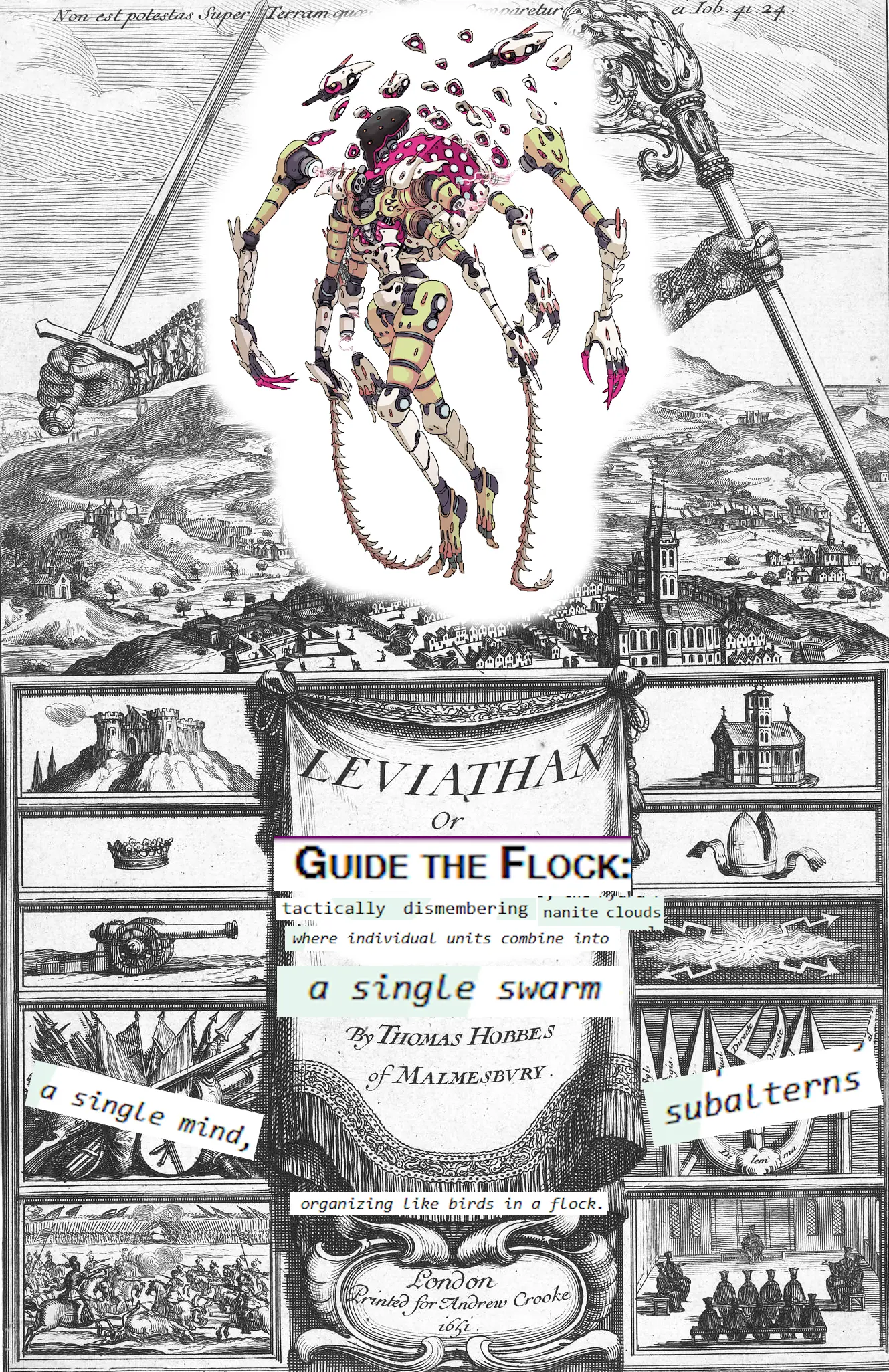
What if rules... but too much??
I had fun making that meme. Anyway, Graeber also talks about why putting rules on play can be tempting but can quickly go too far with the classic example of trying to be a prescriptivist about evolving languages:
The legal order, and hence the zones where state violence is the ultimate enforcer of the rules, has expanded to define and regulate almost every possible aspect of human activity. Thus, as I've said earlier, we end up with regulations prescribing everything from where one can serve or consume different sorts of beverages, how one can work, when one can and can’t walk off from work, to the size of advertisements visible from the street. The threat of force invades practically every aspect of our existence, in ways that would have simply been inconceivable under the rule of Elagabalus, Genghis Khan or Suleiman the Magnificent.
If we think about it, this sort of thing happens all the time—and even in contexts that have nothing to do with arbitrary personal authority. The most obvious example is language. Call it the grammar-book effect. People do not invent languages by writing grammars, they write grammars—at least, the first grammars to be written for any given language—by observing the tacit, largely unconscious, rules that people seem to be applying when they speak. Yet once a book exists, and especially once it is employed in schoolrooms, people feel that the rules are not just descriptions of how people do talk, but prescriptions for how they should talk.
Graeber gives the example of Malagasy, the language spoken in Madagascar, where grammar books were writtin by Christian missionaries 200 years ago, and everyone is taught that 19th century Malagasy in school but speaks modern Malagasy anyways. But anyone who knows someone who insist on correcting with "it's not you and me it's you and I" will probably get the annoyance with grammar books.
Just to bring it back to the top part of this post, RPGs, Utopia of Rules opened up this whole bureaucracy/play/game discussion with a couple paragraphs about DnD in particular. I'll paste them in here because it's funny in an interesting way to hear an anthropologist describe DnD to an audience that probably hasn't heard of it:
Fantasy literature then, is largely an attempt to imagine a world utterly purged of bureaucracy, which readers enjoy both as a form of vicarious escapism and as reassurance that ultimately, a boring, administered world is probably preferable to any imaginable alternative.
Still, bureaucracy and bureaucratic principles are not entirely absent from such worlds. They creep in from several directions.[.. A paragraph about how medieval settings have lots of antibureaucratic magical elements. Fantasy moved from Lord of the Rings and Wizard of Earthsea which he calls antibureaucratic fantasies to Harry Potter which is definitely set in a modern bureaucratic setting.]
How could have happened? Well, one reason is that genres of popular fiction are increasingly not confined to books. (This is especially true if children or adolescents are in any way involved.) Nor do they just extend into movies and television series: there are also everything from board games to models, puzzles, and action figures, multiple forms of fan literature, zines, fan art, video and computer games. In the case of the fantasy genre, it’s impossible to understand the later direction of the literature without first of all understanding the rise, in the late seventies, of the role-playing game Dungeons & Dragons, which allowed hundreds of thousands of teenagers across the world to effectively improvise their own fantasy worlds and fantasy adventures, as if they were collectively writing the story or script of their own adventures in real time.
D&D, as its aficionados call it, is on one level the most free-form game imaginable, since the characters are allowed to do absolutely anything, within the confines of the world created by the Dungeon Master, with his books, maps, and tables and preset towns, castles, dungeons, wilderness. In many ways it’s actually quite anarchistic, since unlike classic war games where one commands armies, we have what anarchists would call an “affinity group,” a band of individuals cooperating with a common purpose (a quest, or simply the desire to accumulate treasure and experience), with complementary abilities (fighter, cleric, magic-user, thief …), but no explicit chain of command. So the social relations are the very opposite of impersonal bureaucratic hierarchies. However, in another sense, D&D represents the ultimate bureaucratization of antibureaucratic fantasy. There are catalogs for everything: types of monsters (stone giants, ice giants, fire giants …), each with carefully tabulated powers and average number of hit points (how hard it is to kill them); human abilities (strength, intelligence, wisdom, dexterity, constitution …); lists of spells available at different levels of capacity (magic missile, fireball, passwall …); types of gods or demons; effectiveness of different sorts of armor and weapons; even moral character (one can be lawful, neutral, or chaotic; good, neutral, or evil; combining these produces nine possible basic moral types …). The books are distantly evocative of Medieval bestiaries and grimoires. But they are largely composed of statistics. All important qualities can be reduced to number. It’s also true that in actual play, there are no rules; the books are just guidelines; the Dungeon Master can (indeed really ought to) play around with them, inventing new spells, monsters, and a thousand variations on existing ones. Every Dungeon Master’s universe is different. The numbers are in a sense a platform for crazy feats of the imagination, themselves a kind of poetic technology.
Still, the introduction of numbers, the standardization of types of character, ability, monster, treasure, spell, the concept of ability scores and hit-points, had profound effects when one moved from the world of 6-, 8-, 12- and 20-sided dice to one of digital interfaces. Computer games could turn fantasy into an almost entirely bureaucratic procedure: accumulation of points, the raising of levels, and so on. There was a return to the command of armies. This in turn set off a move in the other direction, by introducing role-playing back into the computer games (Elfquest, World of Warcraft …), in a constant weaving back and forth of the imperatives of poetic and bureaucratic technology. But in doing so, these games ultimately reinforce the sense that we live in a universe where accounting procedures define the very fabric of reality, where even the most absolute negation of the administered world we’re currently trapped in can only end up being yet another version of the exact same thing.
Graeber then uses this whole DnD setup to motivate his argument that what lies behind the appeal of bureaucracy is a fear of unstructured play, which I pasted above.
Anyways, I really like seeing adult-to-adult interactions through the lens of play and specifically elaborate games. Not just the obvious stuff of "ah, DnD is a game" but also "ah, arguing about the rules of DnD is a game" or even "ah, homebrewing rule changes to WH40k is a game, and it's fun to bend rules to our will than the other way around."
All this leads really well into Heaven Will Be Mine, my favourite lesbian space mecha philosophy visual novel. One of the banger things that that piece of media gets across is fighting each other in giant mechs is also a form of play! As opposed to industrial warfare that uses stuff like MLRS rocket and artillery spotters, giant dueling mechs are way more fun because they're a cool way to play! I won't talk about that part too much though, I just think it's a neat connection.
Play! Games! Rules!